Welcome to my new blog

Shadows of the Valley
When one first looks at Gordale Scar by James Ward it provides a straightforward image of a valley shadowed over by a dark storm. The piece of work can look beautiful or a villainous evil depending on the perspective one takes. This can be related to how Frankenstein is ever changing between light and dark. One can also justify that the valley within the painting will inevitably become fully engulfed by darkness just as Frankenstein’s monster is finally turned to pure evil in the ending. Lastly the rigid, course, and dark edges of the valley relates to how much of the monster is unrefined and roughly pieced together.
Shelley, Mary. Frankenstein. 1818, 1831. Introduction and Notes by Karen Karbiener. Barnes and Noble
Ward, James. Gordale Scar. The Norton Anthology of British Literature: The Romantic Period. 10th ed. Stephen Greenblatt, General Editor. W. W. Norton, 2017. p. C4.
The Similarities of a Mariner and a Rose
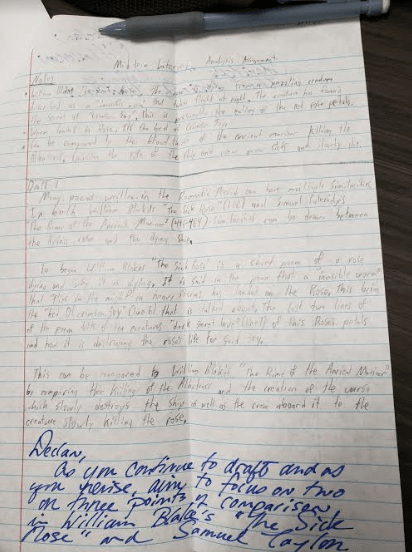
Many poems written in the Romantic Period can have multiple of the same similarities and themes. In both William Blake’s “The Sick Rose” (138) and Samuel Coleridge’s “The Rime of the Ancient Mariner” (448-464) similarities can be drawn between the dying rose and the dying ship.
To begin, William Blake’s “The Sick Rose” (138) is a short poem of a rose dying and the causes behind its death. The poem begins by saying that a rose is sick. This is followed by saying that an “invisible worm” that “flies in the night” in heavy storms has landed on the rose. This being the “bed, of Crimson joy” (138) that is talked about in the second stanza. This moves us to the second to last line of the poem where it describes the creatures “dark secret love” (138) of this rose’s petals. With the poem’s concluding line being “Does thy life destroy” (138). Meaning the creature is destroying the rose’s petals for it’s “Crimson joy” (138).
This poem can be compared to Samuel Coleridge’s “The Rime of the Ancient Mariner”. In the “Rime of the Ancient Mariner” a mariner unknowingly kills a good omen in the form of an albatross while at sea setting a curse upon him and the ship. This curse slowly kills the crew of the ship through illness until only the mariner remains on the ship. The ship then drifts towards land with no apparent reason besides the cursed spirit allowing the rescue of the cursed mariner. With the removal of the mariner from the ship it suddenly sinks. The curse then confines the mariner to land forcing him to tell his tale every few years. The killing of the Albatross and with that the creation of the curse that slowly kills the ship and crew aboard it can be compared to the “invisible worm” slowly killing the rose. In Samuel Coleridge’s poem the Ancient Mariner kills an albatross for seemingly no other reason besides bloodthirst. This albatross is said to have been a good omen and killing it in turn brought a curse upon the ship and its crew. This curse slowly killed the ship and crew until only the Ancient Mariner remained. Just as the Ancient Mariner kills the ship and crew slowly till only he remains, the creature does the same with the crimson rose. The creature lands on the rose and finds the “dark…love” for its petals. With it slowly killing the rose’s petals to only the creature remains. Though the two works are drastically different when doing a simple comparison when looking deeper into both pieces one can find a similarity between the killings of the albatross and the rose.
In conclusion the poems “The Sick Rose” and “The Rime of the Ancient Mariner have a large similarity between each other. While both pieces are incredibly unique compared to the other very similar ideas can be found in both the works. This is justified with the killing of the albatross being compared to the killing of the rose that creates a common idea among the two pieces.
Works Cited
Blake, William. “The Sick Rose.” The Norton Anthology of British Literature: The
Romantic Period. 10th ed. Stephen Greenblatt, General Editor. W. W. Norton, 2017. pp. 138. Coleridge, Samuel Taylor. “The Rime of the Ancient Mariner.” The Norton
Anthology of British Literature: The Romantic Period. 10th ed. Stephen Greenblatt, General Editor. W. W. Norton, 2017. pp. 448-64.
 Declans blog